
The following definition is taken from the Scottish Government’s Schools Policy. You can access the policy by clicking the link following the quote.
- All children and young people have the right to get the support they need to reach their full learning potential.
- In Scotland, we have an inclusive educational system which focuses on overcoming barriers to learning and Getting it right for every child (GIRFEC).
- Some children and young people need additional support to benefit fully from their education.
- Additional support needs can arise, in the short or long term, from a variety of circumstances including:
- the learning environment
- family circumstances
- health or disability needs social and emotional factors
All local authorities in Scotland use a model known as the ‘Staged Intervention Model’. Each local authority will have their own version of the model, with differing numbers of stages, but it should look similar to that shown below.
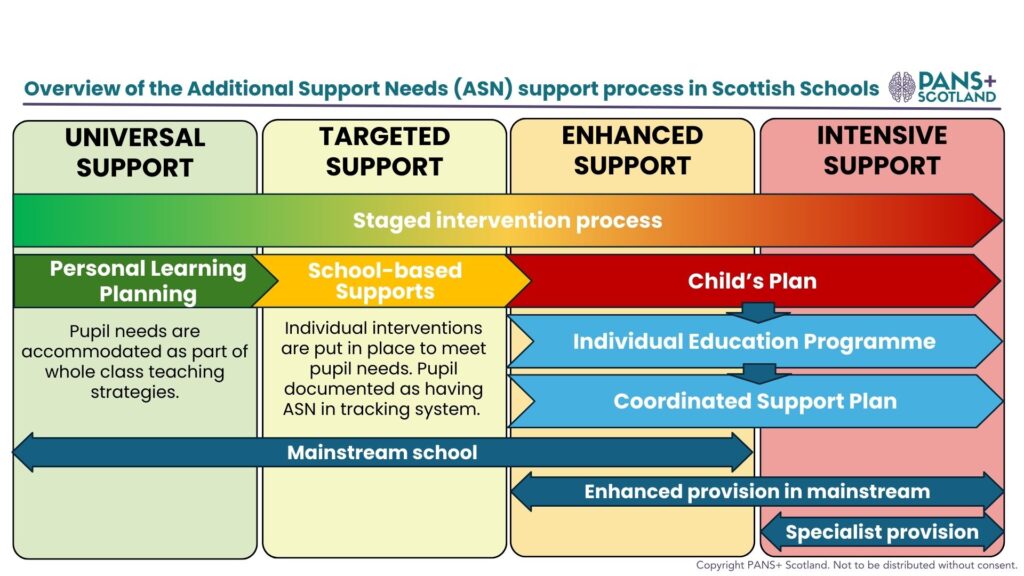
The differences between one local authority and another usually involve how the local authority stages targeted support and enhanced support, with some authorities having multiple levels within those stages. Each local authority should have their model published on their website.
The usual method of working is that the support for a child is increased when interventions at the level below have been tried and are ineffective.
- A Child’s Plan is a non-statutory plan of individualised support for a child or young person.
- It should be developed in conjunction with all agencies supporting the child, at a Child’s Plan Meeting ( sometimes referred to as a multi-agency meeting or MAAP meeting).
- Parents / carers and the child or young person should be present at the meeting, and involved in the development of the plan. If there are tensions with any of the agencies involved, parents/carers may also find it useful to access the services of an independent advocate, who can also attend the meeting.
- The meeting will be minuted, and the minutes should be sent out alongside the Plan agreed at the meeting. If there is anything that parents / carers disagree with in the minutes they can feed this back, and request that the minutes are updated.
- Subsequent meetings will review progress against agreed actions, so although non-statutory, agreed actions are formally documented and reviewed.
Some children and young people may have an Individual Education Programme (IEP). This is a non-statutory document which is used to plan areas of the curriculum that a child needs to have individualised – in other words they are unable to access it in the same way as others, even with targeted support. The IEP will have both long and short term targets.
For more information visit https://education.gov.scot/media/grymd4ev/cfebriefing13.pdf
This is the only statutory plan for education in Scotland, and applies only to children and young people with multiple and complex needs which will have a significant impact on a child or young person’s education. The needs must also be expected to last for at least a year.
Co-ordinated support plans are reputedly difficult to access
For more information visit https://enquire.org.uk/professionals/planning-delivering-asl/co-ordinated-support-plans/
The Additional Support Needs Tribunal is where from parents and young people can appeal against decisions made by education authorities regarding the provision of educational support under the Education (Additional Support for Learning) (Scotland) Act 2004.
For more information visit https://healthandeducationchamber.scot/additional-support-needs/12